
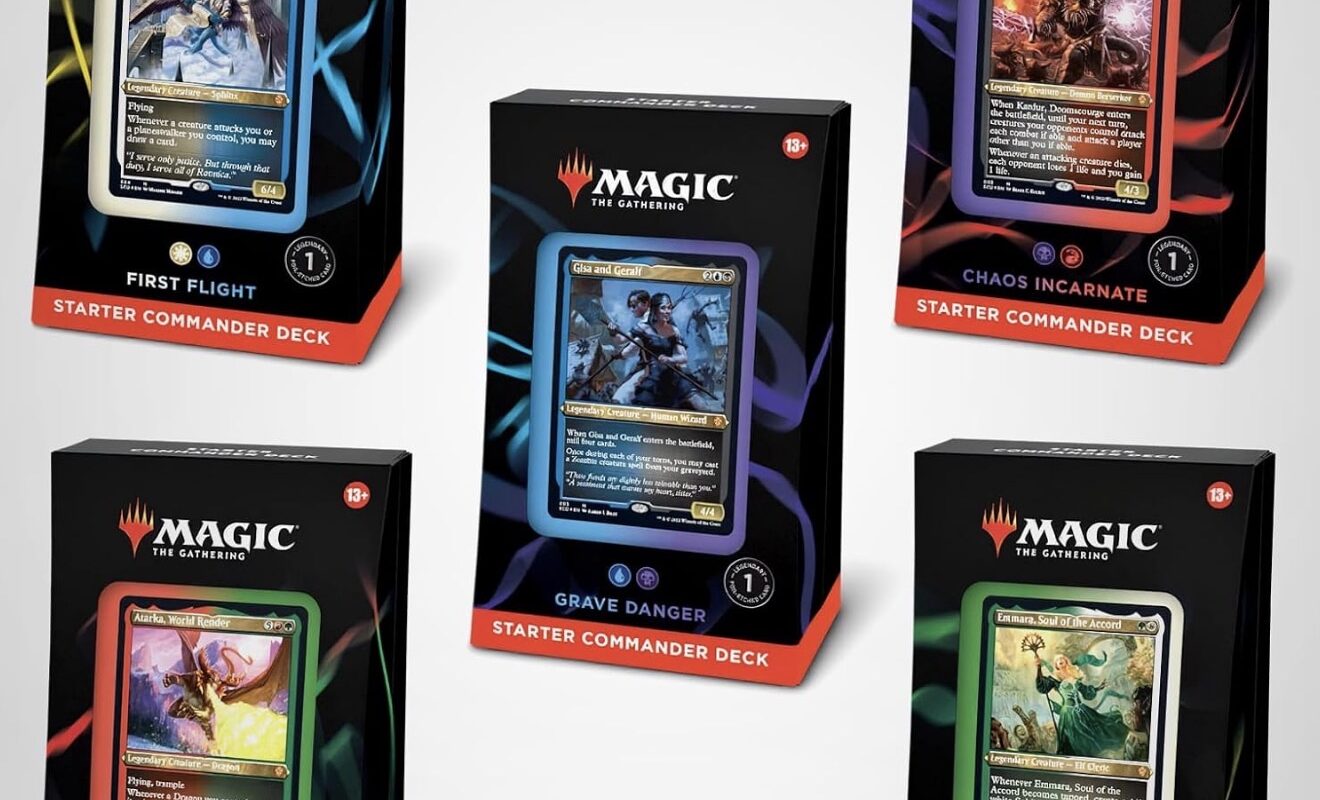
When people ask me the cheapest, easiest way to get a whole family or friend group playing Magic’s most popular format, I point at one product: the Starter Commander Decks. Five ready-to-play decks, one box, no deckbuilding homework, no chase-card lottery. My crew has gotten a ton of table time out of these, and today I’m giving you the full dad-treatment: what Commander even is, how Magic works if you’ve never touched a card, and a walkthrough of all five decks — including which one your most competitive family member is going to fight over.
Fair warning: this is a long one. Bookmark it, come back to it, clip it to the fridge next to the survival calendar.
First: What Even Is Commander?
Commander is Magic’s big, social, multiplayer format — usually four players in a free-for-all — and it’s the beating heart of casual Magic today. Here’s everything a total newcomer needs to know, in plain English:
Your deck has exactly 100 cards, and (except basic lands) no duplicates. One copy of everything. This is called "singleton," and it means every game plays out differently.
One legendary creature leads your deck: your commander. It starts the game face-up in a special spot called the command zone, and you can cast it from there whenever you can afford it. If it dies, you can send it back to the command zone instead of the graveyard and cast it again — though each re-cast from the command zone costs 2 more mana than the last (players call this the "commander tax").
You start at 40 life instead of Magic’s usual 20. Games are longer and swingier, which means more time for comebacks, table talk, and dramatic finishes.
One special way to lose: if a single commander deals you 21 or more combat damage over the course of the game, you’re out — no matter your life total. Keep a rough count when a big commander keeps hitting you.
Color identity: your deck can only contain cards matching your commander’s colors. The precons handle this for you, so just know the rule exists for when you start customizing.
Politics are part of the game. With three opponents, who you attack — and who you don’t — matters. Deals, threats, and "hey, he’s the real problem, not me" are all legal, encouraged, and honestly the best part.
Never Played Magic at All? Sixty-Second Crash Course
The goal: knock each opponent from 40 life to 0. Lands are your resource — play one per turn, tap them for mana, spend mana to cast everything else. Creatures attack and block. Instants can be cast anytime, sorceries only on your turn, and enchantments and artifacts stick around doing useful things.
Your turn, simplified: untap everything, draw a card, play a land, cast stuff, attack with creatures if you want, cast more stuff, pass. Attacking creatures deal their power in damage; defenders can block with untapped creatures. A few keywords carry these five decks: flying (only fliers and reach can block it), trample (extra damage spills through blockers), double strike (hits twice), and lifelink (damage dealt gains you that much life). That’s genuinely enough to play game one — the decks come with reference cards for the rest.
The Box Itself
The Starter Commander Decks released in late 2022 at about $21 per deck (~$100 for the five-deck bundle). Each deck is 100 cards ready to shuffle and play, with a foil-etched commander, tokens, a deck box, and rules inserts. Everything is a reprint — a deliberate choice to keep them cheap and beginner-focused — and every deck includes the format’s three iconic staples: Sol Ring, Arcane Signet, and Command Tower.
The box is out of print now, but it’s still easy to find secondhand at reasonable prices, and it remains one of the best "whole game night in one purchase" products Magic ever made. (If you’d rather buy something currently in print, modern beginner-level precons ship with nearly every set — but for five balanced decks in one box, this is still the one.)
Now, the decks.
First Flight (White-Blue) — Death From Above, Politely
Commander: Isperia, Supreme Judge, a big flying sphinx who lets you draw a card whenever a creature attacks you. Yes, really — she pays you for getting punched, which quietly convinces opponents to punch someone else.
The plan: almost every creature in this deck flies. Most decks can’t block fliers, so you chip away in the air while your removal spells, counterspells, and board wipes (the "destroy everything" reset buttons) keep the ground under control. It plays slow, safe, and reactive.
Cards to watch for: Sephara, Sky’s Blade turns your air force into a real threat; Swords to Plowshares and Counterspell are two of the best answer cards ever printed; Gravitational Shift boosts your fliers while shrinking everyone else’s ground troops.
Who should pilot it: the cautious player — the one who likes having answers and hates overextending. It’s the mechanically simplest deck in the box.
Dad tips: don’t dump your whole hand onto the table (board wipes exist, including yours); hold counterspells for scary things, not the first thing you see; and let Isperia’s card draw grind opponents down over a long game.
Grave Danger (Blue-Black) — The Zombies Keep Coming Back
Commander: Gisa and Geralf, a sibling pair of necromancers who mill four cards off your library when they arrive — and then let you cast one zombie from your graveyard every turn.
The plan: in this deck, the graveyard isn’t where cards go to die; it’s a second hand. You fill your own yard, recast your zombies from it, and grind out value forever. Your creatures dying barely matters — they’ll be back. It’s the deck that teaches the most important lesson in all of Magic: resources are everywhere, not just in your hand.
Cards to watch for: Liliana, Untouched by Death is the deck’s star; Army of the Damned makes a genuinely silly number of zombies; and Gray Merchant of Asphodel — "Gary" to his many fans — can drain a whole table’s life in one dramatic swing.
Who should pilot it: whoever’s most likely to fall in love with the game. This is widely considered the most fun deck of the five, and it rewards repeat plays as you learn its rhythms.
Dad tips: don’t be scared of milling yourself — that’s the engine working; cast your board wipes freely, because you rebuild from the graveyard way faster than everyone else; and recast a zombie every single turn, even a cheap one. Value adds up.
Chaos Incarnate (Black-Red) — Let’s You and Him Fight
Commander: Kardur, Doomscourge, a demon whose arrival forces your opponents’ creatures to attack — and not you. Then, every time an attacking creature dies, all your opponents lose life and you gain some. You’re not the aggressor; you’re the arms dealer.
The plan: turn the table against itself. Force combat between your opponents, sprinkle in effects that drain everyone as the bodies pile up, and clean up what’s left. This deck is a four-player special — the more opponents fighting each other, the better it gets.
Cards to watch for: Blasphemous Act wipes the board for pennies; Dictate of the Twin Gods doubles ALL damage, which gets out of hand delightfully fast; Chaos Warp answers literally any permanent.
Who should pilot it: the family agent of chaos. You know exactly who I mean. Fair warning — it’s the fiddliest deck of the five, with the most triggers to track, so give it to someone who doesn’t mind a little bookkeeping.
Dad tips: time Kardur’s arrival for when opponents have full boards to throw at each other; remember his forced-attack effect happens when he enters, so re-casting him re-triggers it; and lean into the politics — "I mean, you HAVE to attack someone" is your catchphrase now.
Draconic Destruction (Red-Green) — Big Dragons Solve Everything
Commander: Atarka, World Render, a massive dragon with flying and trample who grants your attacking dragons double strike — meaning every dragon you swing hits twice.
The plan: ramp your mana with spells like Cultivate, then start dropping enormous dragons and turning them sideways. That’s it. That’s the whole strategy, and it is glorious. No tricks, no subtlety — present the biggest threats on the table and dare anyone to have answers.
Cards to watch for: Steel Hellkite can clear an opponent’s board after it connects; Scourge of Valkas deals damage every time a dragon shows up; Thunderbreak Regent punishes anyone who dares remove your stuff.
Who should pilot it: the newest player who still wants to win, or anyone whose favorite Magic card is "big dragon." Simple plan, huge payoff.
Dad tips: spend your early turns on ramp even when it feels boring — dragons two turns early win games; with Atarka out, do the double-strike math before attacking, because one swing can delete a player; and expect the table to gang up on you, because — well, keep reading.
Token Triumph (Green-White) — Death by a Thousand Soldiers
Commander: Emmara, Soul of the Accord, a humble two-mana elf who creates a 1/1 lifelinking Soldier token every time she becomes tapped — including every time she attacks.
The plan: go wide. Where the dragon deck builds a few giant threats, this deck builds an army of small ones, then casts a team-wide pump like Overrun to turn twenty tiny soldiers into one lethal stampede. There’s something deeply satisfying about winning with a swarm of 1/1s.
Cards to watch for: March of the Multitudes makes soldiers by the handful; Champion of Lambholt grows until your whole team is unblockable; Ajani, Caller of the Pride can end games out of nowhere.
Who should pilot it: the builder — the player who likes watching a board grow and setting up one big turn. One heads-up: this deck struggles against fliers, which means the sphinx and dragon decks are its bad matchups. Give it to someone who enjoys an underdog arc.
Dad tips: get Emmara down turn two, every game, and attack with her freely — even if she’s blocked, you made a token and gained life; hold your big team pump until it’s lethal instead of telegraphing it; and rebuild fast after board wipes, because you’re better at that than anyone.
So Which Deck Wins? (The Family Politics Section)
Here’s the community consensus, and my table agrees: Draconic Destruction is the strongest deck in the box and usually wins the pod if left alone. Grave Danger is the most fun. First Flight is the simplest, and can quietly overperform because the other decks struggle to block fliers. Token Triumph got squeezed hardest by the budget and has the roughest matchups. Chaos Incarnate is genuinely well-designed but needs a full table to shine.
What do you do with that information? The same thing my family does: if the dragon player wins three games in a row, the table is allowed and encouraged to gang up on them. That’s not unsporting — that’s Commander. Threat assessment is the real game. Alternatively, spend $10–15 upgrading each of the other decks (every one of these has cheap, well-documented upgrade paths) and the field levels right out.
The Dad Verdict
For the price of one video game, you get five decks, a complete introduction to Magic’s most popular format, and a repeatable family game night where everyone’s on roughly equal footing. Nobody has to build anything, nobody’s deck cost more than anybody else’s, and the skills transfer directly to every Commander table on Earth.
Start everyone on the deck that matches their personality, expect the dragon player to get smug, and let the politics flow. And when someone at your table inevitably asks "wait, can I do this in response?" — congratulations. You’ve made a Magic player. Welcome to the best part of the hobby, friends. My table’s door is always open.